Tuesday, 11 December 2007
While you wait ... !

Wednesday, 25 July 2007
The effects of war at home 2

A goose egg with hens' eggs
[Couldn't find a picture of pig swill anywhere!]
However, as a result of being at a vegetarian school, my brother and I had vegetarian ration books. To begin with we were able to change these in the holidays so that we could get meat, but eventually the government discontinued the practice, and we had to manage. Our parents gallantly shared their tiny meat ration with us, but our veggie ration books gave us access to additional cheese and eggs, and more in the way of nuts and dried fruit than was available to eveybody. I remember too a delicious cashew nut butter known as Nutter, which made a really tasty spread. As most women had to do, unless they were prepared to buy on the black market, my mother became expert at contriving nourishing meals out of not very much.

A typical weekly ration for one - enough cholesterol there for a week for me nowadays, even without the black pudding which I don't fancy!
A rather posh neighbour of ours kept a Jersey cow on her lawn for a time, as her ‘contribution’ to the war. She kindly offered to leave out two glasses of rich creamy milk every day, in her lovely cool dairy, and my brother and I were expected to walk down the hill and back again to take advantage of this extra nourishment. I remember it being a rather boring obligation which we did not appreciate! However, it did not last long, as our neighbour was soon notified that all the product from her cow which was surplus to her own household’s needs, was expected to be handed over to the Milk Marketing Board for fair distribution – she was not supposed to give it away to friends!
I think the worst thing I suffered personally as a teenager, as a result of the war, was the clothes I sometimes had to wear made over from my mother’s by a local dressmaker. I could tell that they were not stylish and they embarrased me. Only a few years ago I was using up a set of dusters which my mother had bought with a view to turning them into some sort of garment. Thank goodness that project was never realised! Incidentally, I still have left one or two of the black satinised cotton curtains we used to black out our windows. Over the years these have been made up into a variety of fancy dress costumes for school plays and local amateur dramatics.

We all suffered as a family for a while, when we gave houseroom to my father’s sister from London, together with some other London relatives. This was extremely tough for my mother, with two other women in her kitchen, and she became very stressed and tearful. The other family lived in a different way from us, and I can remember our horror on one occasion when they had prepared a cauliflower cheese for our supper, and it had come to table absolutely full of aphis which had not been washed out before cooking. I am afraid we made a bad hand of having evacuees in the house, even family, and I feel a bit ashamed when I think of all those other families who had no choice about taking in strangers.
The effects of war at home 1

My father picking apples
We had not known the village prior to the war, as we arrived only in the July before war was declared in September. Village life was pretty simple then in any case. I have already written that we had neither mains electricity, water or sewage. I think we had a car in the early weeks of the war, although later it had to be taken off the road, as petrol was rationed, and used for essential purposes only. As I recall, apart from tradesmen who had to make deliveries, cars were mostly owned by the better off in those days, with two-car families being a rare occurrence. So people walked to where they had to go: to their work, to the shops, to school, to the pub, and to church.
The village had only three shops, as I remember: a baker, a butcher and a post office and general store. Fortunately we had our milk delivered; we lived next door to a farm and the milk arrived in a churn, still warm, and often with little black floaters in it, as it was not treated in any way at that time. It was ladled out into our own jug or milk can which we left on the doorstep.
The bulk of our shopping had to be done in the local town of Worcester which was seven miles away. By the time the war was well under way, the local bus service to the town was down to once a fortnight. It was a 10-15 minute walk downhill from our house to the bus stop, but probably half an hour up hill again, to get home with heavy bags loaded with tinned goods, dry goods, vegetables, clothes - everything that was needed for the next two weeks of living.
But once my father had the smallholding working well, with fruit and vegetables to take to market, as well as the eggs from the hens kept by my mother, it was necessary to have some form of transport to get the produce into the town. For a while we ran a pony and trap, which we parked in the car park alongside whatever cars were there. The first pony we bought turned out to have been doped by the crooked dealer, and became unmanageable as soon as we got him home. The second buy, an amiable little Welsh pony called Mick, turned out fine, and my brother and I were able to ride him as well.

My brother and I with Mick the pony
Wednesday, 20 June 2007
The end of schooling
 The school floodlit on VE night
After this delightful break I must have had to turn immediately to revision for my final exams. I recall the sweltering agony of writing them in a suffocating hall during a heatwave summer. I remember too how, if we had two exams in a morning, we would be given handfuls of nuts and raisins during the break to keep up our energy levels. We didn’t have a tuck shops or machines in the school, and there would not have been time to sneak out to the local corner shop for forbidden refreshments .
On the whole I had found learning easy at St Christopher, except for Science, which I did not understand, and History which bored me. I was lucky to have first class teachers in all my favourite subjects: English, French, Spanish, and Biology. Even in Maths I ended up with a teacher who somehow managed to make sense of it for me, so that I was able, to my own astonishment (and probably to his), to get a credit in my School Certificate Exam (GCSE equivalent in the UK). After that I was able, thankfully, to drop the subject.
 The Lower Sixth [I'm 2nd from L at the back]
 The Upper and Lower Sixth forms 1944
Boarding school - the effects of war
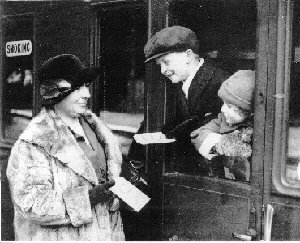 During some of the worst bombing attacks on London, instead of travelling from Worcester to school at Letchworth, via Paddington and Kings Cross, my brother and I were dispatched via Oxford and Reading, a long and dreary route without the benefit of our school mates as company on the train. Instead of being met and transported across London by my father’s sister, my parents arranged for an organisation called Universal Aunts to get us from train to train at the intermediary stops. They are still in existence, and still performing the role of proxy parents (among many others) all these years later. They have been going since 1921, and I have taken the liberty of reproducing one of their archive pictures of ‘Meeting the train’.
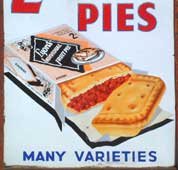
 I have written before of the vegetarian diet at our boarding school. At the start of the war meat dinners were on offer twice a week for those children whose parents wanted them to have meat. But these were soon abandoned, due to the difficulties of buying both meat and vegetarian food with ration books. Although I thrived on the vegetarian diet, and thought I might remain vegetarian after leaving school (I did not in fact), I still had an occasional yearning for meat. It was one of our regular naughty escapades to go down into the town where a mobile café served spam and chips for an affordable sum. Another of our favourite food supplements was a threepenny Lyons Individual Fruit Pie from the local corner shop.
 None of this can really be called hardship, but we were called upon to make some contribution to ‘the war effort’. There were days when we were sent off to help local farmers with lifting their potato crops, armed with a packed lunch and a large bottle (glass of course) filled with weak sweet tea. There were also harvest camps in the summer holidays, when we went off to stay on farms in Lincolnshire for a week or two during the harvest season. It was extremely hard work, but fun as well, as this sort of communal effort usually is. The picture shows washing up duty on a day when I was not sent out into the field. [Double click on it to see a larger version.]
 Oh yes, and I was elected to the Economy Committee in my senior years, which entitled me to go around annoying the hell out of people by switching off unnecessary lights and turning down central heating. I wasn’t all that popular anyway, but I couldn’t resist the bossy role!
Some of our male staff left to go to war, of course, and one of them became a well-known war correspondent for the Daily Telegraph (Christopher Buckley). Sadly he lost his life later in Korea, having almost taken the decision to retire after World War II. Another was the housemaster of whom I wrote in my other blog in “Escape artist”. He left behind a disconsolate wife and small son, and I do remember that her temper became extremely short during his absence, which I hope we had the understanding to forgive.
That lovely couple, who ran their school boarding house with a firm but enlightened hand, has remained in my heart, (along with the principal and his wife), as the role models of my choice. Some thirty years later I had the good fortune to find myself on a channel ferry with them crossing from Belgium to England, and they carried me off to have breakfast with them in Cambridge, where I had a date with my dentist. They had eventually left the school to run an international school of their own in Switzerland.
Sunday, 10 June 2007
Boarding school - affairs of the heart

A's ring
My next admirer was B., a year older than me. He and I would take walks through the Hertfordshire countryside during the summer term, and the smell of May blossom, or of Queen Anne’s lace, or the stubble fields of harvest time under a sweltering sun, have always tended to raise the sap in my veins again, in recollection of those early stirrings. B. too made an offering for me in the craftshop, a beautifully turned wooden candlestick. This too I have kept, and it is brought out at Christmas with a red candle in it. My mother inadvertently caused me great distress, when I was still living at home, by washing the candlestick in an attempt to remove the wax spatterings. Unfortunately this destroyed the beautiful polish which it had been given, and it never looked quite the same again. I found it difficult to forgive her!
G. was the first boy I set my sights on and pursued unilaterally. Shamelessly, I would take every opportunity to talk to him, and would often plonk myself down beside him at one of the work tables in the library, and sit studying next to him. That must have been very annoying for him. I don’t think he was ever really interested in me, but showed remarkable patience for some time, even when I escaped from my dormitory one night to visit him in his sleeping hut in the school grounds. He put a good face on it, got out of bed and suggested we take a walk. We went across the school field and into the apple orchard. I think it must have been September, as the fruit was ripe on the trees and starting to fall. The scene was wreathed in mist, and lit by a gentle luminosity from the moon. Out of nothing more than this my romantic heart created an occasion of real magic, which glimmers imperishably in my memory. But soon after that he got me off his hands, apparently by asking another boy to take me on, though I didn’t find that out until much later.
And so I turned my attention to E., who had actually invited me to go for a walk with him. Another occasion of the utmost magic: an October night with a wild wind blowing, and copper coloured clouds scudding across a lurid moon. We took our romantic walk, believe it or not, along the Great North Road, which must have been a deal more rural around Letchworth in the 1940s than it is today. We cuddled a bit, and talked, and as far as I was concerned I was well and truly hooked. But alas, I didn’t hold his attention for very long either, although I yearned over him for the rest of my school days. Which reminds me that in my spare time I also wrote a great deal of soppy poetry, in both English and French! I will spare my readers that however.

B's candlestick
Footnote - Strange customs develop in a closed community: acknowledged pairs would exchange friendship pins, and the girl would wear her boy’s jacket over her shoulders. When she no longer wore it you knew the girl had been ‘dropped’! (Roll on Women's Lib!)
Thursday, 7 June 2007
Boarding school - escape artist
I was a pretty good at escaping while at school in Letchworth – preferably at night, out of windows and down fire escapes. I don’t mean that I wanted to escape from the school – far from it – but that I wanted to escape from my dormitory for the purpose of unauthorised meetings with boys.
I made a trial run at the age of about 13, before I had any real interest in the male of the species. This was just sheer naughtiness, giving in to the temptation of being where we shouldn’t, and I was not alone on this occasion. We went into a teacher's bedroom and climbed out of the window and onto the roof. Of course we were discovered, and received a severe talking to by the house father. (Boarding houses were run by married couples.) But I think what made the biggest impression on me was not the fierceness of the wigging he gave us, but the long, long time he sat at the piano afterwards, playing sombre music, with stern disappointment on his face. He was a man I liked and respected, and it pained me to have upset him so much.
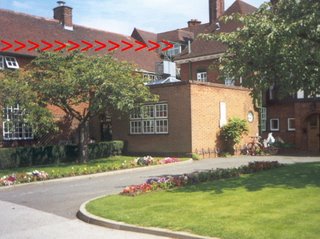
 But that didn’t stop me a year or two later, when I wanted to leave my bedroom and make my way to where my particular 'crush' of the moment was sleeping. It was a school designed to give us the maximum advantage of fresh air, in addition to the vegetarian diet and Quaker principles, and in the senior school the boys slept in wooden huts or brick ‘cells’, built outside the main building. Hence the need for escape routes. When I returned for an old scholars’ reunion in 1997,
 I took great delight in photographing the two routes which I remembered, one from a first-floor dormitory and over a balcony, and one from a second-floor bathroom and down a fire-escape. I have marked the exit points on the pictures here.
On the first occasion the unfortunate youth did not know I was coming – I have always been inclined to pick my own quarry and start the chase myself – but he put a good face on it, got out of bed and suggested we take a walk. There was a school field, of course, and lawns, kitchen gardens and an orchard. I think it must have been September, as the apples were ripe on the trees and starting to fall. The scene was wreathed in mist, and lit by a gentle luminosity from the moon. My romantic heart created an occasion of real magic, which glimmers imperishably in my memory.
Regrettably, the young man never really took a fancy to me – (saw him at that reunion, bald as a coot. Oh! where are all the golden boys and girls?) – and he asked another boy to take me off his hands, though I didn’t find that out till much later. This other fella also suggested a walk, so off I went again.
 Another occasion of the utmost magic: an October night with a wild wind blowing, and copper coloured clouds scudding across a lurid moon. We took our romantic walk, believe it or not, along the Great North Road, which must have been a deal more rural in the 1940s than it is today. We cuddled a bit, and talked, and as far as I was concerned I was hooked for the rest of my school days, though once again I failed to hold his attention. (Clearly, I was going to be a late developer!) The other day I found a sonnet I wrote after that walk along the Great North Road. Urrghh! It was sickening - I won’t inflict it on you.
Footnote - Strange customs develop in a closed community: acknowledged pairs would exchange friendship pins, and the girl would wear her boy’s jacket over her shoulders. When she no longer wore it you knew the girl had been ‘dropped’! (Roll on Women's Lib!)